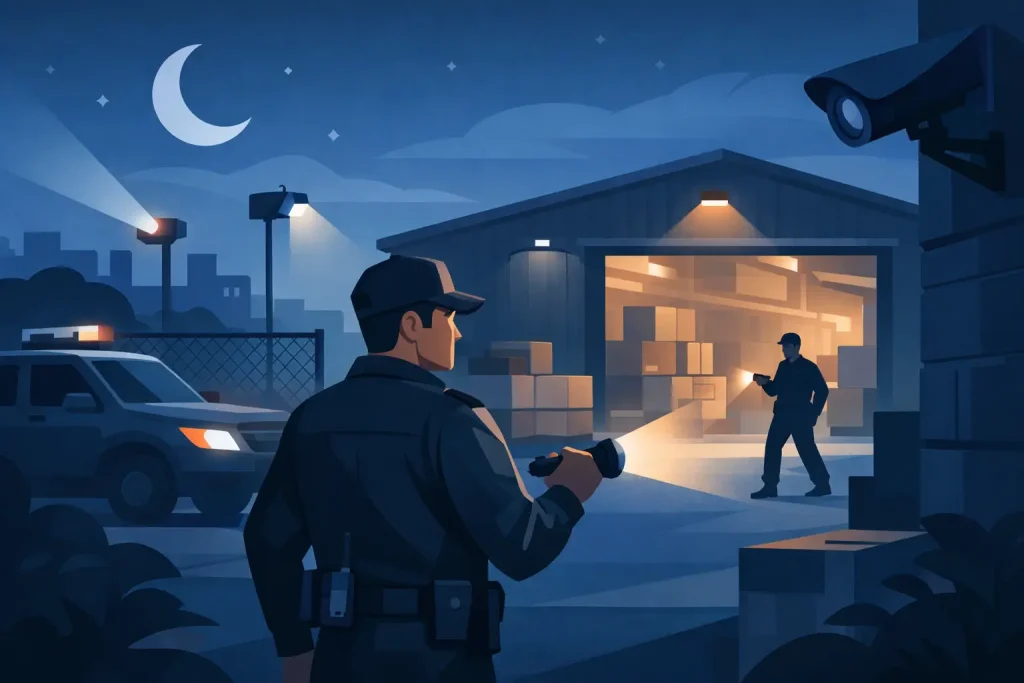
A warehouse can look quiet after the last shift leaves, but the risk profile often rises at that point. Loading docks, trailer yards, fenced perimeters, employee entrances, and inventory areas can become targets for theft, trespassing, vandalism, or unauthorized access. Overnight warehouse security guards provide visible, accountable coverage when facility staff is limited and response time matters most.
For warehouse owners, logistics operators, and property managers, overnight protection is not simply about placing a person at a gate. Effective coverage is built around the way the site operates, where goods move, which areas remain accessible after hours, and what the guard should do when an alarm, delivery, or suspicious activity occurs.
Why Warehouses Need Protection After Hours
Warehouses hold more than inventory. They may contain vehicles, forklifts, tools, fuel, electronics, raw materials, shipping records, keys, access credentials, and equipment that is difficult to replace quickly. A single overnight incident can disrupt deliveries, delay production, create insurance issues, and put employees at risk when the morning shift arrives.
Many facilities also have large footprints and multiple access points. A chain-link fence alone does not confirm that every gate is closed, every dock door is secured, or every visitor has a legitimate reason to be on the property. A trained security officer can verify conditions in real time rather than leaving site protection to cameras and alarms alone.
Visible guard coverage changes the calculation for people looking for an easy opportunity. A uniformed officer conducting foot patrols, checking trailer yards, and monitoring entrances creates an active presence that cameras cannot provide. When an issue develops, the officer can assess the situation, contact management or emergency services, document what occurred, and help protect the scene.
What Overnight Warehouse Security Guards Do
The right assignment depends on the facility, but overnight warehouse security guards typically combine access control, patrol activity, and incident response. At a staffed gate or entrance, the officer can verify drivers, employees, contractors, and scheduled deliveries before allowing access. This is especially valuable when shipments arrive early, vendors work after hours, or trucks stage in the yard overnight.
Patrol duties should be specific to the site. An officer may check pedestrian gates, dock doors, fencing, exterior lighting, storage areas, employee parking, and high-value equipment. Regular patrols also identify operational problems that could become security issues, such as an unsecured door, a damaged lock, a disabled camera, or an unfamiliar vehicle near the building.
Alarm response is another major reason to maintain on-site coverage. Alarms may be triggered by attempted entry, employee error, power interruptions, or equipment issues. A guard who already knows the property can investigate within established safety procedures, notify the appropriate contacts, and provide accurate information to responding law enforcement or fire personnel.
Professional officers also maintain activity logs and incident reports. These records give management a clear account of patrols, visitors, deliveries, unusual conditions, and actions taken. For facilities with recurring concerns, documentation can reveal patterns such as repeated trespassing near a specific fence line or unauthorized vehicles entering through an unmonitored gate.
Standing Guards, Mobile Patrols, or Both?
A standing guard is often the best fit when a warehouse needs continuous control at a single location. This may include a main entrance, guard shack, vehicle gate, reception area, or loading dock. The officer remains available to screen visitors, observe incoming traffic, enforce site rules, and respond quickly to activity in the immediate area.
Mobile patrol service can be a cost-effective option for lower-risk sites, vacant warehouses, multi-building industrial properties, or facilities that need periodic checks rather than a full-time officer. A patrol officer can inspect the property at scheduled or randomized intervals, confirm that access points are secure, and respond to alarm notifications.
Some sites benefit from both. A distribution center with overnight truck activity may need a standing guard at the gate while a patrol officer checks the perimeter, exterior storage, and distant trailer areas. The right approach depends on the value of assets, the size of the property, surrounding activity, operating hours, past incidents, and the budget available for protection.
Build Coverage Around Real Warehouse Risks
Generic guard instructions create gaps. A warehouse security plan should begin with a practical assessment of the facility’s vulnerabilities. The goal is to determine where a person could enter unnoticed, what property is most exposed, and which procedures need to be followed during the overnight shift.
High-value inventory may require frequent patrols near designated storage areas. Facilities with outdoor equipment may need dedicated checks of tool cages, fuel storage, vehicle keys, and heavy machinery. A site with recurring illegal dumping or trespassing may need more attention along its perimeter, while a busy logistics center may require detailed driver verification and trailer tracking.
Clear post orders keep everyone aligned. They should explain who is authorized to enter, how to handle unscheduled deliveries, when to notify management, where to conduct patrols, and when law enforcement or fire personnel should be called. Guards should not be expected to improvise critical procedures at 2:00 a.m. because site expectations were never defined.
Communication is equally important. The officer needs current emergency contacts, instructions for alarm panels and gate controls, an understanding of restricted areas, and a reliable way to report incidents. Management should also receive useful reports, not vague notes that offer little information about what was observed or done.
Choosing a Qualified Security Partner
Warehouse security requires officers who can stay alert during long overnight hours while remaining professional with drivers, employees, vendors, and first responders. In California, clients should confirm that guards are properly BSIS-licensed and that the provider uses screening, drug testing, training, and supervision practices appropriate for the assignment.
Experience matters, but so does flexibility. A provider should be able to adjust coverage when a facility changes schedules, expands a trailer yard, experiences an increase in theft, or needs temporary support after an incident. Security needs can shift quickly during peak shipping periods, construction activity, holidays, or vacancy between tenants.
Price should be evaluated alongside readiness and accountability. The lowest hourly rate can become costly if guards arrive late, posts are left uncovered, reports are incomplete, or site instructions are ignored. A competitive security program is one that fits the actual risk, maintains dependable coverage, and avoids paying for services the property does not need.
Mursheed Protection Security Services develops customized guard and patrol programs for industrial and commercial properties throughout Los Angeles, Orange, Riverside, and San Bernardino counties. A free security assessment can help identify whether a fixed overnight officer, mobile patrols, access control, alarm response, or a combination of services is the most practical solution.
Questions to Settle Before Coverage Starts
Before assigning an officer, facility management should decide which overnight activities are expected and which are prohibited. Is the guard authorized to admit scheduled drivers? Should employees be required to show identification after a certain hour? Are there areas that must remain locked even for authorized personnel? Simple answers to these questions prevent confusion during the shift.
It is also wise to establish escalation procedures for common events. For example, a guard may document and report a damaged fence, but a forced entry or active confrontation requires a different response. The officer’s role is to observe, deter, report, and respond within training and site procedures, not to take unnecessary risks.
A well-run overnight assignment should be reviewed periodically. If incident reports show repeated activity at one location, patrol routes or lighting may need to change. If guards are spending significant time processing legitimate truck traffic, the facility may need a dedicated access-control post rather than relying on intermittent patrols.
Reliable overnight protection gives warehouse leadership more than a guard at the property. It gives them a trained presence that can notice problems early, maintain control after hours, and help the facility open the next morning with fewer surprises.