
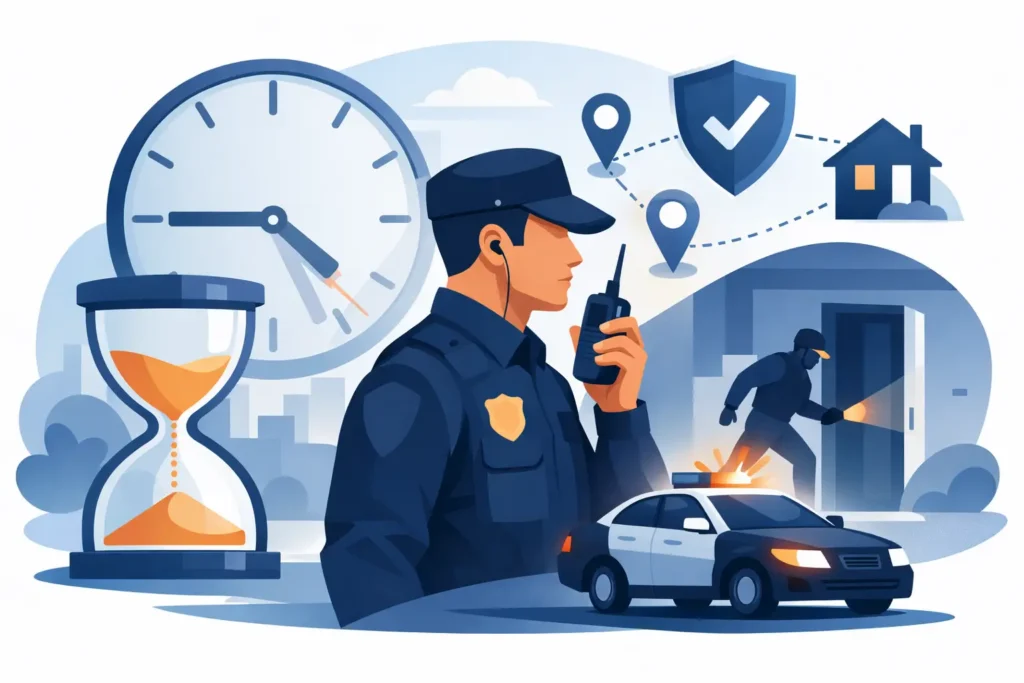
A broken gate alarm at 2:00 a.m. creates a different level of exposure than a routine parking complaint during business hours. In both cases, security guard response time affects what happens next: whether a situation is verified quickly, whether unauthorized activity is deterred, and whether the property manager has clear information to act on. For Southern California properties, the best response plan is not simply the one that promises the lowest number of minutes. It is the one built around the site, the risk, and the type of incident.
What Does Security Guard Response Time Mean?
Security guard response time is the time between a reported incident, alarm activation, or request for service and the arrival of a trained security officer at the location. That definition sounds simple, but property owners should clarify exactly when the clock begins and what “response” includes.
For an alarm response, the timeline may start when an alarm monitoring center notifies the security provider. For a tenant complaint, it may begin when a manager contacts dispatch. For an on-site issue at a staffed property, the relevant measure could be how quickly the assigned officer reaches a particular building, parking structure, or access point.
Arrival is only one part of the job. A useful response also includes assessing the scene, identifying immediate hazards, preserving safety, contacting law enforcement or emergency services when required, documenting the incident, and notifying the client according to the agreed protocol. A guard who arrives promptly but cannot access the affected area, communicate with management, or follow site procedures may not deliver the protection the situation requires.
Why Faster Is Not Always the Whole Answer
A fast response can reduce opportunity for theft, trespassing, vandalism, and unauthorized access. It can also reassure tenants, employees, residents, and visitors that an active security presence is in place. At construction sites, for example, a rapid patrol response after an intrusion alert may help prevent equipment theft or damage before losses expand.
However, speed without preparation has limits. An officer responding to a disturbance needs current site instructions, contact information, gate codes, access credentials, and a clear understanding of when to request police, fire, or medical assistance. An armed or unarmed guard also must stay within training, authority, and applicable California requirements.
The practical goal is dependable response, not an unrealistic blanket promise. A provider should explain how coverage is deployed, what could affect travel time, and how the site can be prepared for the most likely incidents. That level of planning is more valuable than vague assurances.
Factors That Affect Security Guard Response Time
Response time depends on the operating model. A standing guard is already on the property, while a mobile patrol officer may be covering multiple nearby locations. Both can be cost-effective choices, but they solve different problems.
On-Site Coverage Versus Mobile Patrols
A dedicated officer typically provides the quickest available physical presence because the officer is already at the site. This approach is often appropriate for active commercial properties, gated communities, high-traffic facilities, sensitive access points, or locations with repeated incidents. Foot, bike, and vehicle patrol patterns can then be adjusted to cover vulnerable areas at specific times.
Mobile patrol services can be a more affordable option for properties that do not need continuous staffing. Patrol officers may perform scheduled checks, lock-up services, perimeter inspections, and alarm response. Actual arrival time will depend on the officer’s current patrol location, traffic conditions, call volume, and distance to the property.
For many clients, the right answer is a combination: scheduled mobile patrols during lower-risk hours and a standing guard during high-risk shifts, special events, move-ins, construction activity, or periods of recurring crime.
Property Layout and Access
A large industrial yard, a multi-building apartment community, and a downtown office tower each create different response challenges. Guard access can be slowed by locked gates, unclear addresses, poor lighting, unmarked entrances, elevator delays, or inaccurate contact lists.
Property managers can improve operational readiness by providing current gate codes, key instructions, maps, approved parking locations, emergency contacts, and details on known hazards. A guard should not lose valuable time searching for the correct entrance or waiting for a contact who is unavailable.
Incident Type and Priority
Not every call has the same urgency. A suspicious person near a closed loading dock, a burglary alarm, a fire-watch concern, and a noise complaint may each require a different response protocol. Clear priorities help dispatch send the right officer and ensure the client understands when emergency services should be contacted immediately.
Security guards are not a substitute for 911 during an active life-safety emergency, fire, medical emergency, or crime in progress. A well-designed security plan identifies when the guard responds, when the guard observes from a safe position, and when law enforcement or fire personnel take the lead.
Traffic, Distance, and Local Conditions
Los Angeles, Orange, Riverside, and San Bernardino counties cover a wide area with very different traffic patterns. A provider that is responsive in one city may not be positioned to deliver the same arrival window in another. Road closures, freeway congestion, special events, weather, and simultaneous incidents can all affect a mobile officer’s travel time.
This is why local deployment matters. A security company should assess where patrol officers are assigned, how dispatch communicates with them, and whether backup resources are available when activity increases.
How to Build a Better Response Plan
The strongest response plans begin before the first alarm or incident. They are based on a site assessment that identifies where problems occur, when they occur, and what actions should follow. A free security assessment can reveal simple gaps, such as an unsecured rear gate, a camera blind spot, inconsistent lock-up procedures, or no documented contact chain after hours.
Start by identifying the property’s highest-risk periods. A retail center may need greater coverage during closing and cash-handling hours. A construction site may need patrol attention overnight and on weekends. A residential community may need visible patrols around parking areas, package rooms, and gated entrances after dark.
Then establish site-specific post orders. These instructions should tell officers how to enter the property, where to patrol first, how to handle alarms, who to call, when to escalate, and how reports should be delivered. They should also address practical details such as vendor access, parking enforcement, resident or tenant interactions, and areas where officers should not enter alone.
Finally, review the plan after incidents. If the same gate is repeatedly found open or a particular section of the property generates alarms, the solution may be a revised patrol route, additional lighting, access-control changes, or targeted standing guard coverage. Security should adjust to actual conditions, not remain fixed because it was included in an old contract.
Questions to Ask a Security Provider
Before selecting a provider, ask how dispatch receives and prioritizes calls, how officers communicate while on patrol, and what reporting is available after an incident. Ask whether the company can provide standing guards, vehicle patrols, alarm response, lock-up services, fire watch, and temporary coverage as needs change.
It is also reasonable to ask about guard licensing, screening, drug testing, training, supervision, and local service availability. In California, properly licensed officers and clear supervision support more consistent service. The lowest hourly price is not always the lowest cost if poor coverage leads to repeated theft, property damage, tenant complaints, or management time spent chasing incident details.
A dependable provider should be willing to discuss limitations as well as capabilities. If a requested response target cannot be reliably supported by the proposed patrol model, the provider should recommend a different deployment rather than overpromise.
Measuring Response Time the Right Way
Property owners should avoid judging performance from one incident alone. Instead, review trends over time. Compare dispatch records, arrival times, incident reports, patrol verification, and client notifications. Look at whether officers followed instructions, whether the situation was stabilized appropriately, and whether recurring risks were identified.
A response that takes a few additional minutes but includes accurate reporting, proper escalation, and a recommendation that prevents the next incident may create more value than a quick arrival with no follow-through. Accountability comes from clear expectations and documented performance.
Mursheed Protection Security Services builds coverage around each client’s vulnerabilities, operating hours, and budget, with highly trained California BSIS-licensed guards available 24 hours a day, 7 days a week. Whether a property needs permanent staffing, mobile patrols, or emergency coverage, the deployment should match the real exposure instead of forcing the site into an inflexible package.
The right security guard response time is the one supported by a prepared property, trained officers, practical dispatch procedures, and a coverage plan that can hold up when the call comes after hours.