
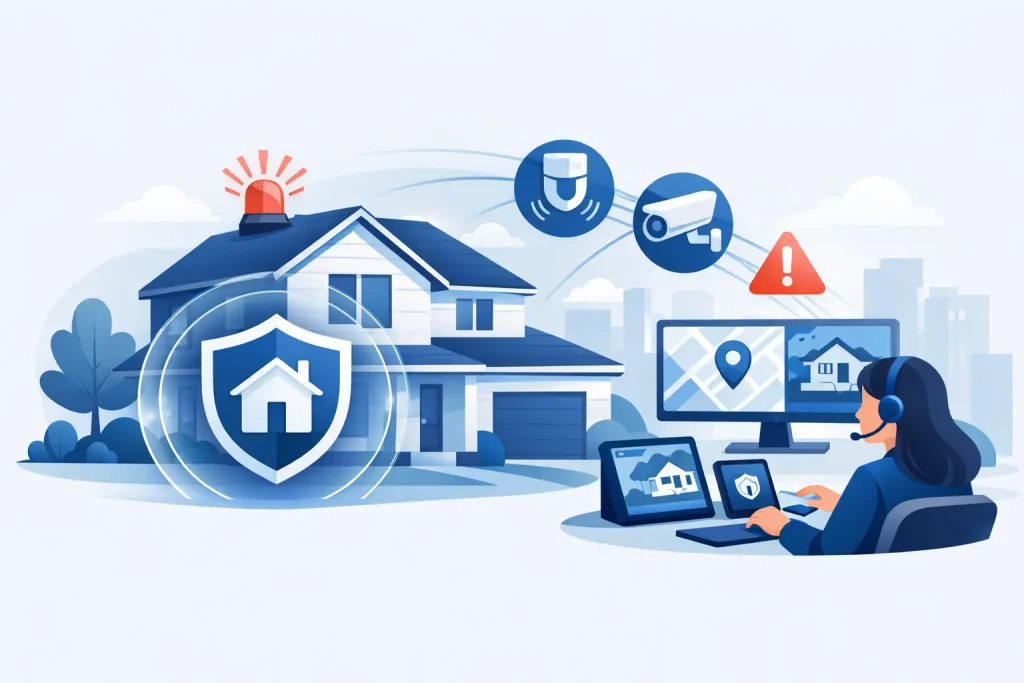
A storefront alarm activates at 2:13 a.m. A construction gate sensor trips over a weekend. A resident reports a fire panel alert when the office is closed. In each case, alarm monitoring determines whether the incident becomes a documented, timely response or an unanswered signal that leaves a property exposed.
For property owners and managers, an alarm system is only one part of the security plan. The equipment can detect an opened door, motion in a restricted area, a perimeter breach, or a life-safety issue. What happens after the signal is received is what protects the site, supports accountability, and helps reduce loss.
What Alarm Monitoring Actually Does
Alarm monitoring is the ongoing process of receiving alarm signals, evaluating the information available, following a response protocol, and documenting the event. Depending on the system and service arrangement, the monitoring center or designated security provider may contact authorized personnel, dispatch a patrol officer, request law enforcement or fire department assistance, or take several of these steps in sequence.
The right response is not identical for every property. A false alarm at an office suite may require verification and a keyholder notification. An active intrusion alarm at an equipment yard, apartment community, or retail location may call for a trained officer to check the perimeter, inspect access points, preserve the scene, and report conditions to the client. A fire-related signal requires a different escalation path altogether.
This is why a response plan matters as much as the alarm panel itself. A signal without current contact information, access instructions, site maps, and clear escalation authority can create delays at the exact time a property needs direction.
Why Monitoring Is More Than an Alarm Notification
An alarm notification tells someone that a signal occurred. Effective alarm monitoring turns that notice into an operational decision. It establishes who receives the alert, who is authorized to make decisions, how the property is accessed, and when on-site security, emergency services, or management should be involved.
For many Southern California properties, the most practical benefit is avoiding a vulnerable gap after business hours. Managers cannot reasonably be expected to drive to every late-night alarm, especially when the site may involve a forced entry, trespasser, damaged gate, or unknown hazard. A trained security officer can provide a professional on-site presence while the situation is assessed.
This also protects staff from being placed in situations they are not trained or equipped to handle. A receptionist, maintenance employee, or assistant property manager should not have to investigate a possible break-in alone. Security response gives management a defined process instead of relying on whoever happens to answer the phone.
The value of visible response
A visible patrol vehicle or uniformed officer can deter continued activity at a site after an alarm is triggered. If a door has been forced open or a gate has been left unsecured, the officer can help identify the issue, maintain observation, and notify the appropriate contacts according to the post orders.
Response also creates documentation. Incident reports can record the time of the alarm, site conditions, persons contacted, observed damage, police case information when available, and corrective actions taken. That record is useful for property management, insurance follow-up, vendor coordination, tenant communication, and identifying recurring security weaknesses.
Building the Right Alarm Response Plan
A cost-effective program begins with a site-specific assessment. The goal is not to add services that a property does not need. It is to understand the most likely risks and make sure the response is realistic for the location, operating hours, layout, and budget.
A warehouse with high-value inventory may need a priority response for perimeter and loading-dock alarms. A condominium association may focus on clubhouse access, pool gates, parking areas, and common-area doors. A construction project may need alarm response combined with overnight vehicle patrols because equipment, copper, tools, and temporary fencing are frequent targets.
The following operational details should be defined before an alarm incident occurs:
- Authorized contacts, including primary and backup decision-makers available after hours.
- Clear dispatch instructions for intrusion, panic, fire, gate, and supervisory signals.
- Access procedures, such as keys, codes, lockbox locations, gate entry instructions, and restricted areas.
- Escalation thresholds for calling law enforcement, fire personnel, management, restoration vendors, or other parties.
- Reporting expectations, including incident reports, photos when appropriate, and immediate notifications for serious events.
These details should be reviewed regularly. A response plan becomes unreliable when a former employee remains on the contact list, a gate code changes, a construction site expands, or a tenant moves into a previously vacant suite.
When a Guard Response Makes Sense
Not every alarm requires an on-site officer, but many properties benefit from having one available 24 hours a day, 7 days a week. Guard response is particularly valuable when management is off-site, when alarm activity has been recurring, or when a location has a history of theft, vandalism, trespassing, or unauthorized entry.
A trained guard can approach the property with awareness, inspect designated exterior areas, check for obvious signs of forced entry, and follow instructions without taking unnecessary risks. If criminal activity is suspected, the officer can request law enforcement assistance and observe from a safe position. Guards are not a replacement for police, fire, or medical professionals, but they provide immediate security presence and informed reporting while the proper agency is contacted.
For occupied communities and commercial sites, the officer’s role may include reassuring residents or employees, keeping unauthorized people away from a damaged entrance, coordinating with a keyholder, and maintaining a log of actions taken. This is especially helpful after a burglary alarm, gate malfunction, broken glass incident, or alarm-related access problem.
Mursheed Protection Security Services can structure alarm response alongside mobile patrols, standing guard coverage, lock-up service, or access control duties. That flexibility allows clients to add visible coverage where the actual risk supports it rather than paying for a rigid package that does not fit the property.
Common Gaps That Weaken Alarm Protection
The most common problem is assuming that monitoring alone resolves the security issue. A monitoring center can receive and communicate information, but it cannot physically secure a broken door, inspect a dark parking area, or remain at the site while a damaged gate is repaired. That is where a coordinated security response plan becomes necessary.
Another gap is poor alarm maintenance. Repeated false alarms can lead to frustration, unnecessary dispatches, and slower decision-making when a real incident occurs. Property managers should track false alarm patterns. Loose doors, failing sensors, low batteries, faulty motion detectors, pest activity, and inconsistent employee procedures can all create avoidable activations.
Access control is also closely connected to alarm performance. An alarm may tell you a door opened, but it may not tell you why the door was left unsecured or whether an authorized person used the entrance improperly. Reviewing access logs, camera footage, patrol reports, and alarm history together gives management a clearer view of the issue.
Finally, do not overlook the human side of the plan. Tenants, employees, residents, and contractors should know who to call after hours and when not to enter a site following an alarm. Clear instructions reduce confusion and help keep people from walking into an unsafe situation.
Choosing a Monitoring and Response Provider
When comparing providers, ask practical questions about availability, dispatch procedures, reporting, training, and pricing. A low monthly rate may not reflect the actual cost if response calls, reports, patrol mileage, or after-hours coverage are handled as expensive add-ons. On the other hand, paying for full-time guard coverage may not be necessary for a site that needs periodic patrol and reliable alarm response.
Look for a provider that can explain exactly what occurs after an alarm signal, who communicates with the client, how officers are dispatched, and what is included in the report. California BSIS-licensed guards, proper screening, continuing training, and site-specific post orders all contribute to more dependable service.
The best arrangement is one that matches the property’s risk level and changes as conditions change. A retail center may need additional response coverage during holiday inventory periods. A vacant building may require stronger patrol presence until it is leased or renovated. A community dealing with repeated vehicle break-ins may need targeted patrol checks around peak incident times.
A well-planned alarm response program gives property decision-makers more than a phone call in the middle of the night. It gives them a reliable next step, a trained presence when it is needed, and a clearer path to keeping the property secure after the signal sounds.
Pingback: Vehicle Patrol Versus Standing Guard: Which Fits? – MURSHEED PROTECTION INC. SECURITY SERVICES