
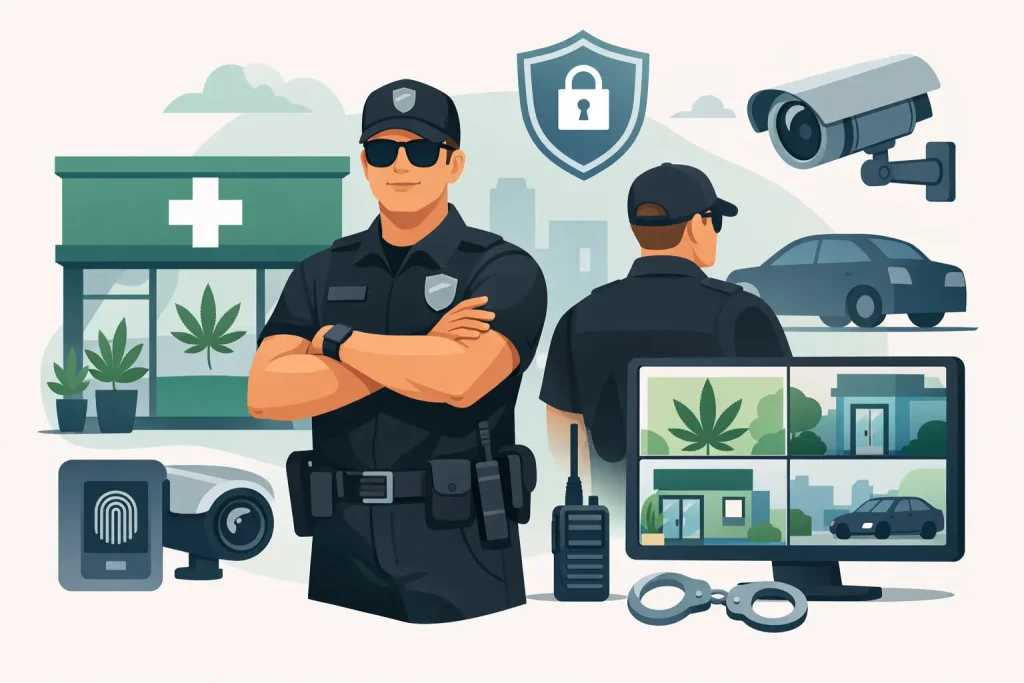
A dispensary can have cameras, reinforced display cases, and a compliant point-of-sale system, yet still face its greatest exposure at the front door, in the parking lot, or during a cash-handling transition. Cannabis dispensary security guards provide the visible, trained presence that helps protect employees, customers, inventory, and daily operations when those pressure points arise.
For Southern California operators, security cannot be treated as a generic add-on. Every location has a different layout, customer flow, neighborhood profile, delivery schedule, and operating budget. The right guard program should reduce risk without making legitimate customers feel unwelcome or forcing the business into coverage it does not need.
Why Dispensaries Need a Site-Specific Security Plan
Cannabis businesses often manage risks that overlap: valuable inventory, cash transactions, restricted areas, high customer traffic, and heightened public attention. Theft can come from outside the property, but it can also involve unauthorized access, weak receiving procedures, poor key control, or gaps during opening and closing.
A trained security officer creates more than a visible deterrent. The officer observes activity, enforces access procedures, documents incidents, checks vulnerable areas, and gives staff a clear point of contact when something does not look right. That presence can prevent a minor concern from escalating into a disruption that affects customers, employees, and the business’s reputation.
The most effective program begins with a security assessment. A provider should review entry and exit points, sight lines, parking areas, employee-only doors, camera coverage, alarm response procedures, delivery activity, and closing routines. A busy retail storefront may need a professional officer at the entrance during business hours, while a lower-traffic facility may benefit more from scheduled mobile patrols and lock-up service. It depends on the site’s actual vulnerabilities, not a one-size-fits-all package.
What Cannabis Dispensary Security Guards Do
The day-to-day role of a dispensary guard is practical and operational. At the entrance, an officer can maintain an orderly customer line, monitor who enters, identify suspicious behavior, and help keep restricted areas secure. Inside the facility, the officer stays alert to shoplifting concerns, conflicts, unattended items, and attempts to access employee-only spaces.
Outside, visible patrols can discourage loitering, vandalism, trespassing, and vehicle break-ins. Parking areas deserve attention because employees and customers are often most vulnerable when arriving or leaving, especially after dark. A guard who regularly checks the perimeter also notices conditions that cameras may not resolve quickly, such as a propped-open rear door, damaged fencing, or an unfamiliar vehicle parked near an access point.
Guards should also support the procedures behind secure operations. This may include monitoring deliveries, verifying authorized vendors, observing cash-transfer routines, conducting opening and closing checks, responding to alarms, and preparing detailed daily activity reports. Clear reporting helps management identify repeat concerns and demonstrates that the security program is actively managed.
Professional officers do not replace law enforcement, nor should they create unnecessary confrontations. Their role is to deter, observe, communicate, document, and respond within their training and assignment instructions. When a serious threat occurs, guards should know how to protect people, preserve the scene when appropriate, and contact emergency services without delay.
Armed or Unarmed Coverage: Making the Right Choice
Whether a dispensary needs armed or unarmed officers depends on its risk profile, local requirements, hours, location, and operational preferences. An unarmed guard can be the right choice for many retail environments where the priority is access control, customer service, visible deterrence, and professional incident handling. The officer remains highly visible while maintaining a more approachable environment for customers.
Armed coverage may be appropriate for sites with elevated exposure, significant cash-handling concerns, late-night operations, or a history of credible threats. However, armed security requires careful planning. The provider must supply properly qualified personnel, establish clear post orders, and ensure the assignment supports the business’s broader safety procedures. Armed guards should never be selected simply because they appear more imposing.
A combination approach can be cost-effective. For example, a dispensary may use an unarmed standing guard during normal retail hours, scheduled vehicle patrols overnight, and additional coverage for high-value deliveries or special events. This gives the operator reliable protection where it is needed most while controlling contract security costs.
The Qualities That Matter in a Guard Provider
Dispensary owners and managers should look beyond a low hourly rate. Inconsistent staffing, weak supervision, poor reporting, and officers who are unfamiliar with the assignment can cost far more than a properly managed security contract. Reliability is part of the protection itself.
A qualified provider should use California BSIS-licensed guards and maintain a disciplined hiring and training process. Screening, drug testing, continuing training, supervisor accountability, and clear communication all affect how an officer performs when the site is busy or an incident occurs. A uniformed officer who arrives on time, understands post orders, and communicates professionally gives staff confidence and sends a clear message that the property is protected.
Responsiveness matters as much as initial planning. A dispensary’s needs can change quickly after a nearby incident, an alarm event, a change in business hours, or a construction project that creates new access points. A security partner available 24 hours a day, 7 days a week can adjust coverage, dispatch emergency support, and help management address a security gap before it becomes a larger problem.
Build Procedures Guards Can Actually Follow
Even highly trained guards need clear direction. The best post orders are specific enough to guide decisions without becoming an unrealistic stack of paperwork. They should explain who is authorized in restricted areas, how to handle customer disputes, where to conduct patrols, which doors require checks, when to contact management, and when to call law enforcement or emergency services.
Opening and closing procedures deserve particular attention. Assign responsibilities for checking doors, gates, alarms, exterior lighting, and parking areas. Establish how staff will coordinate during cash-handling tasks and what to do if a person remains near the property after closing. These routines should be practiced, not merely filed away.
Communication between guards and staff should be professional and consistent. Managers should know how to report a concern, request an adjustment in patrol activity, and review incident reports. Guards should receive timely information about employee changes, delivery schedules, maintenance work, and any person-specific concerns that may affect the assignment.
Protect the Customer Experience While Maintaining Control
Security is most effective when customers notice the professionalism before they notice the enforcement. A guard at a dispensary should be alert, courteous, and capable of giving simple directions without escalating routine questions into conflict. The goal is controlled access and a safe environment, not an intimidating retail experience.
That balance is especially important at the entrance. Customers may need guidance about identification, waiting procedures, parking rules, or store policies. A trained officer can help manage those interactions while allowing sales staff to focus on service. If a conflict develops, the officer can separate parties, de-escalate where possible, and protect the rest of the store from disruption.
Visible security also reassures employees. When staff know a trained officer is available to address suspicious activity, escort them to vehicles, or respond to an aggressive visitor, they are better able to perform their jobs with confidence. That practical reassurance supports retention as well as day-to-day safety.
Plan for Change, Not Just Today’s Conditions
A security program should be reviewed after any incident, operational change, or seasonal shift in traffic. A new neighboring business, altered store hours, changes to parking access, or recurring loitering can all affect the type of coverage a dispensary needs. Incident reports and patrol observations provide useful evidence for making those adjustments.
Mursheed Protection Security Services can help Southern California dispensary operators evaluate these details and develop customized armed, unarmed, patrol, access-control, and alarm-response coverage at competitive pricing. The objective is not to sell unnecessary hours. It is to place highly trained guards where they will have the greatest impact on safety and accountability.
A well-run dispensary security program gives employees a dependable response plan, customers a safer place to shop, and management a clearer view of what is happening on the property. Start with the vulnerabilities that are most likely to interrupt your operation, then build coverage that is prepared to meet them.
Pingback: Who Needs Armed Guards? A Practical Assessment – MURSHEED PROTECTION INC. SECURITY SERVICES