
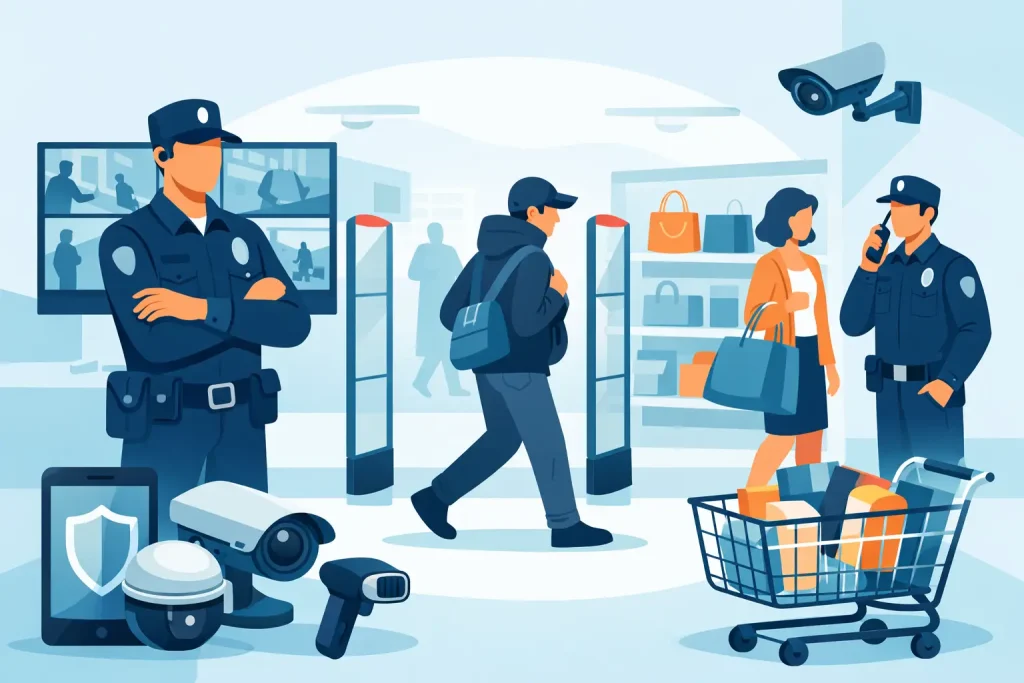
A concealed camera may help document a loss after it happens. Retail theft prevention guards help change what happens before a theft can occur. A visible, professional officer at the entrance, on the sales floor, or near high-value merchandise sends a clear message: this store is actively protected.
For Southern California retailers, theft prevention is not limited to shoplifting. It can involve organized retail crime, employee theft, return fraud, parking lot incidents, trespassing, aggressive behavior, and unauthorized access through receiving areas. The right guard program addresses the risks specific to the location while protecting the customer experience that keeps people coming back.
Why Visible Guard Coverage Changes Retail Risk
Most retail losses are not prevented by one measure alone. Cameras, electronic article surveillance tags, locked displays, inventory controls, and employee training all have a role. But these tools may not provide an immediate, professional response when a suspicious situation develops.
A trained security officer adds a human presence to the operation. Guards can observe behavior, conduct visible patrols, monitor entrances and exits, check receiving doors, document incidents, and contact law enforcement when necessary. Their presence can discourage opportunistic theft while giving employees a clear person to call when a concern arises.
This matters especially when a store is short-staffed, carries easily resold products, stays open late, or has experienced repeated incidents. Employees should be able to focus on customers and normal store duties. They should not be expected to confront suspected thieves or manage volatile situations without proper training.
The goal is not to make a retail environment feel hostile. It is to make security visible, alert, and controlled. A courteous guard who welcomes customers, watches key areas, and remains available to staff can strengthen both safety and service.
What Retail Theft Prevention Guards Do on Site
Retail security is most effective when officers have clear post orders rather than a vague instruction to “watch the store.” The daily assignment should reflect the site’s layout, store hours, inventory, loss history, staffing levels, and known trouble areas.
At the front of the store, a guard may provide a professional greeting while observing customer flow, bags, carts, and exit activity. On the floor, the officer may conduct irregular patrols through departments with high-value merchandise and maintain a visible presence near fitting rooms, electronics, cosmetics, alcohol, tools, or seasonal displays.
In back-of-house areas, guard duties may include checking service entrances, monitoring delivery activity, verifying that exterior doors remain secured, and watching for unauthorized access. For shopping centers and standalone stores, patrol coverage can also include the parking area, loading zones, dumpsters, and perimeter doors.
When an incident occurs, the officer’s role is to respond according to post orders, company policy, and applicable law. That can include observing and reporting, notifying management, separating involved parties when safe, preserving video or other information, documenting facts, and requesting law enforcement assistance. Professional reporting is valuable because repeat incidents often reveal patterns that need a broader security response.
Deterrence Works Best When Coverage Is Consistent
A guard appearing only after an incident may help manage the immediate problem, but consistent coverage has greater deterrent value. People who intend to steal often look for routine gaps: an unmonitored side door, a shift change, a quiet evening period, or an unsecured receiving area.
Coverage does not always require a full-time officer at every hour. A smaller retailer may benefit from targeted evening coverage, weekend support, or mobile patrol checks. A larger location with significant foot traffic or repeated theft may need a standing guard throughout operating hours. The practical answer depends on the risk, not on a one-size-fits-all package.
Choosing the Right Guard Program for Your Store
The first question is not whether to hire armed or unarmed guards. It is where losses and safety concerns are actually occurring. A security assessment should identify the conditions creating exposure, including blind spots, weak access points, limited staff visibility, late-night operations, prior incidents, and the distance from law enforcement response.
Unarmed guards are a strong fit for many retail environments. Their visible presence, observation skills, access control duties, and ability to communicate professionally can reduce risk without creating an overly intense atmosphere for customers. They are often appropriate for entrances, sales floors, shopping centers, grocery stores, pharmacies, and retail plazas.
Armed guard coverage may be appropriate when a location faces higher-risk conditions, such as repeated violent incidents, high-value inventory, cash-intensive operations, or a credible threat profile. This decision should be made carefully, with attention to the site’s risks, local requirements, guard qualifications, and the expectations of customers and employees. More force is not automatically better security. The coverage must be proportional to the environment.
Mobile vehicle patrols can supplement on-site officers or provide cost-effective protection when continuous standing coverage is not necessary. Patrol officers can check exterior doors, parking areas, loading zones, and alarm conditions at scheduled or varied times. For retailers in multi-tenant centers, this can be an efficient way to improve perimeter visibility.
Security Procedures Matter as Much as Guard Presence
Even highly trained guards need a defined operating plan. Store managers and security personnel should agree on who receives incident reports, which areas require regular checks, when management must be notified, and how emergency calls are handled. Clear procedures prevent confusion during a fast-moving situation.
Staff should also know what security can and cannot do. Employees should be encouraged to report suspicious conduct promptly, avoid personal confrontation, and preserve their own safety. A guard can act more effectively when staff share useful details such as a location, description, direction of travel, or an unsecured door.
It also helps to review the physical environment. Merchandise placement, lighting, mirror placement, locked cases, checkout visibility, receiving-door controls, and camera coverage all affect how well guards can observe the site. Security officers are most effective when the store design supports clear lines of sight and controlled access.
For recurring issues, incident reports should lead to adjustments. If theft spikes near closing time, shift coverage may need to extend later. If a receiving door is repeatedly left unsecured, management may need a stricter access process. If parking lot disputes are becoming common, patrol activity may need to increase during peak periods. Security should be managed as an ongoing operation, not a fixed setup that never changes.
What to Look for in a Retail Security Provider
Retailers should look beyond a low hourly rate. A guard program that is inexpensive on paper but suffers from missed shifts, weak supervision, or poor reporting can cost far more through preventable losses and operational disruption.
A dependable provider should offer properly screened, California BSIS-licensed guards, responsive supervision, clear communication, and the ability to scale coverage for seasonal demand, special events, construction activity, or an immediate security concern. Ask how the provider handles call-offs, whether post orders are customized, how incident reports are delivered, and who is available after regular business hours.
Mursheed Protection Security Services builds programs around the site, the risk level, and the client’s budget. That may mean a standing officer during the highest-risk hours, mobile patrol support after closing, access control at a loading area, or a broader plan that combines several services. The priority is reliable protection without forcing a store into unnecessary coverage.
A Better Customer Experience Starts With a Safer Store
Retail theft prevention guards are not only there for suspected theft. They can help employees feel supported, give customers a more orderly environment, and provide an immediate point of contact when a conflict, medical concern, parking issue, or suspicious activity arises.
The strongest retail security programs stay visible without becoming disruptive. Start with the vulnerabilities that are costing the store the most, assign trained officers where they can make a real difference, and adjust coverage as conditions change. That approach protects inventory while keeping the focus where it belongs: serving legitimate customers with confidence.