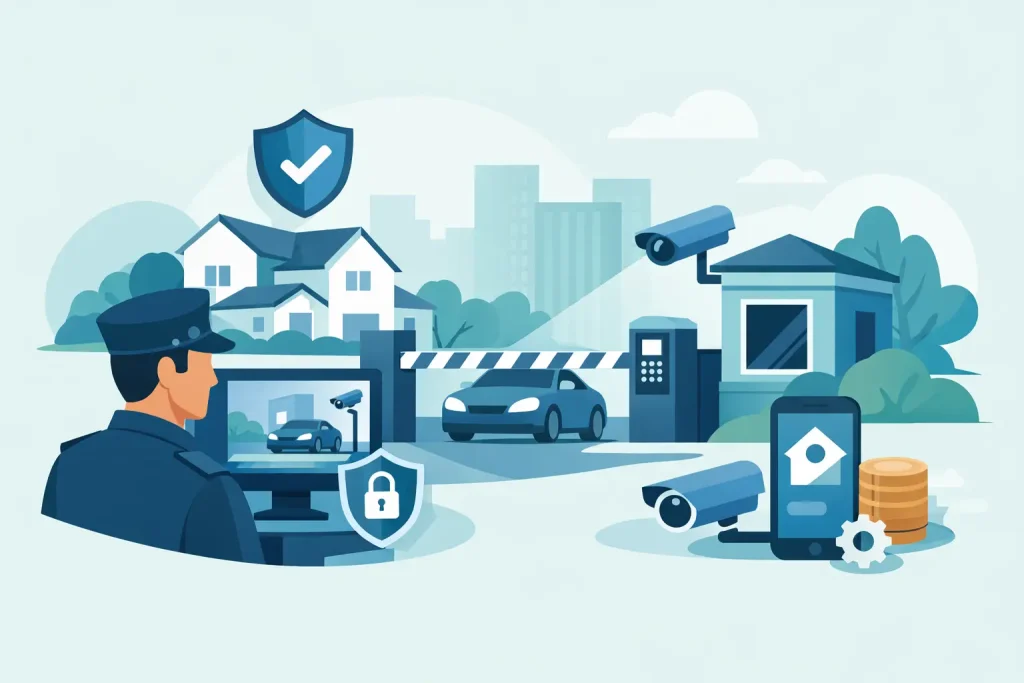
A community gate is more than an entrance. It is where residents expect control, visitors need clear direction, deliveries arrive at all hours, and unauthorized people look for an opening. Effective gate security for communities turns that busy access point into a managed checkpoint without making residents feel like they are entering a restricted facility.
For HOA boards, property managers, and apartment community operators, the goal is rarely to add the most expensive security package available. The goal is to reduce preventable problems: tailgating, trespassing, package theft, parking conflicts, vandalism, and after-hours disturbances. The right gate program provides visible protection, reliable documentation, and a professional presence that fits the community’s budget and daily operations.
Why Community Gates Need Active Security
An automatic gate, keypad, call box, or camera system can help control access, but technology alone does not make a community secure. Gates can be left open, resident codes can be shared, visitors can follow vehicles through the entrance, and equipment can fail at inconvenient times. When there is no trained person or patrol program watching the access point, small gaps can become routine.
A security officer at the gate adds judgment to the process. The officer can verify visitors, observe vehicles, enforce entry procedures, report damage, respond to resident concerns, and identify behavior that a keypad or camera cannot interpret. That visible presence also changes the calculation for people considering unauthorized entry.
Active gate coverage is particularly useful for communities with frequent service traffic, multiple entrances, high-value vehicles, construction activity, recurring trespassing, or a history of parking and access disputes. It can also be valuable during move-ins, holiday weekends, special events, and periods when a gate system is under repair.
What Gate Security for Communities Should Cover
A strong gate security program begins with clear responsibilities. Guards should know who is authorized to enter, which visitor procedures apply, how to handle delivery drivers, and when to escalate an issue to management or law enforcement.
Visitor and vendor verification
The entry process should be consistent without becoming unnecessarily difficult for residents and legitimate guests. Depending on the property, a gate officer may verify a visitor through an approved resident list, call the resident for confirmation, review contractor credentials, or direct delivery personnel to a designated access point.
The best procedure depends on the community. A large apartment complex with constant package deliveries needs a different approach than a gated HOA with limited daily traffic. In either setting, unclear exceptions create security gaps. Property management should establish procedures for vendors, caregivers, real estate showings, movers, rideshare drivers, and emergency service personnel before an incident occurs.
Tailgating prevention and access control
Tailgating happens when an unauthorized vehicle enters closely behind a resident or approved visitor. It is one of the most common weaknesses at gated properties because it can occur in seconds. An attentive gate officer can observe vehicle flow, challenge suspicious entry attempts when appropriate, and document repeated issues for management.
No program can guarantee that tailgating will never happen. Residents also need to understand why they should not hold gates open, share access codes, or let unknown vehicles follow them inside. Security works best when officers, management, and residents are following the same expectations.
Incident reporting and communication
Professional gate security is not just about stopping a vehicle. Officers should maintain clear daily activity reports, visitor logs when required, incident reports, and notification records. Documentation gives managers a practical record of gate malfunctions, recurring violations, suspicious vehicles, damaged property, and resident complaints.
This information helps a community make better decisions. If reports show repeated access attempts near a secondary entrance, management may need more patrol coverage, improved lighting, camera adjustments, or a change in gate hours. Without reliable reporting, a property is left responding to isolated complaints instead of identifying patterns.
Match Coverage to the Community’s Risk Level
Not every community needs a standing guard at the entrance 24 hours a day. For some properties, that level of coverage is necessary. For others, it may exceed the actual risk and budget. Cost-effective protection starts with an honest assessment of the site.
A community with a high volume of visitors, an active clubhouse, frequent contractor traffic, and prior trespassing may benefit from staffed gate coverage during peak hours, plus mobile patrols overnight. A smaller residential community may need scheduled vehicle patrols, lock-up service, and alarm response rather than a full-time gate officer.
The key is to avoid buying coverage based only on appearances. A guard posted during low-traffic hours may not address the community’s real vulnerabilities, while a gate left unmonitored during busy evening arrivals may create avoidable exposure. A security assessment should examine traffic patterns, entrance layout, existing equipment, incident history, lighting, sightlines, nearby public access, and budget priorities.
Technology Helps, but It Does Not Replace Professional Judgment
Cameras, license plate readers, electronic visitor systems, and remote gate controls can improve accountability. They can create records, alert management to activity, and help officers review what occurred after an incident. These tools are especially useful across large properties where one person cannot see every entrance.
However, technology has limits. A camera may capture a vehicle, but it may not prevent an aggressive visitor from entering behind another car. A call box may allow a resident to grant access, but it does not confirm whether the person at the gate is the person expected. Remote monitoring can be useful, but it cannot provide the same visible deterrent or immediate on-site decision-making as a trained officer.
The practical approach is to use technology to support trained guards and patrol officers. Security personnel should understand the site’s access control equipment, know how to report malfunctions promptly, and follow clear procedures when systems are offline. A broken gate should never become an unplanned open-door policy.
Train Officers for Residential Service, Not Just Access Control
Residential gate officers represent the community every time they interact with a resident, guest, vendor, or prospective tenant. They need to be alert and firm, but they also need to communicate professionally. An officer who is dismissive with residents or confrontational with visitors can create unnecessary complaints and weaken support for the security program.
Highly trained guards should be prepared to de-escalate conflicts, enforce community procedures consistently, recognize suspicious behavior, and call for additional support when needed. They should also understand the limits of their authority. Their role is to observe, deter, document, control access according to site instructions, and respond appropriately – not to create avoidable confrontations.
California BSIS-licensed security personnel, proper screening, drug testing, and continuing training matter because community security often involves unpredictable situations. From a dispute at the gate to a resident reporting a suspicious person, officers need sound judgment as much as they need a uniform.
Build Clear Post Orders Before Coverage Begins
Even the most experienced guard cannot protect a site effectively without current, property-specific instructions. Post orders should explain entry procedures, authorized contact lists, emergency contacts, gate operating rules, vehicle restrictions, resident privacy expectations, patrol routes, reporting requirements, and escalation steps.
They should also address common gray areas. What happens when a resident does not answer a call for a visitor? Can food delivery drivers enter? Where should contractors park? Who approves after-hours vendors? What should the officer do if a resident insists on allowing an unverified guest through the gate?
Clear answers prevent inconsistent enforcement. They also protect managers from having to resolve the same issue repeatedly. Post orders should be reviewed whenever the property changes access systems, construction begins, incident patterns shift, or management staff changes.
Choose a Security Partner That Can Adjust
Community needs can change quickly. A gate may be damaged in a vehicle accident, a resident meeting may require additional coverage, or a recent theft may require temporary overnight patrols. A security provider should be able to respond 24 hours a day, 7 days a week and adjust staffing without forcing the community into an inflexible package.
Mursheed Protection Security Services provides customized guard and patrol programs for residential communities throughout Southern California, including Los Angeles, Orange, Riverside, and San Bernardino counties. The right provider should offer a free security assessment, competitive pricing, trained officers, and practical recommendations based on the property’s actual risks.
A well-managed gate does not need to feel intrusive. When access rules are clear, officers are professional, and coverage matches the community’s real needs, residents gain something more useful than a gate code: confidence that someone is paying attention when it matters.